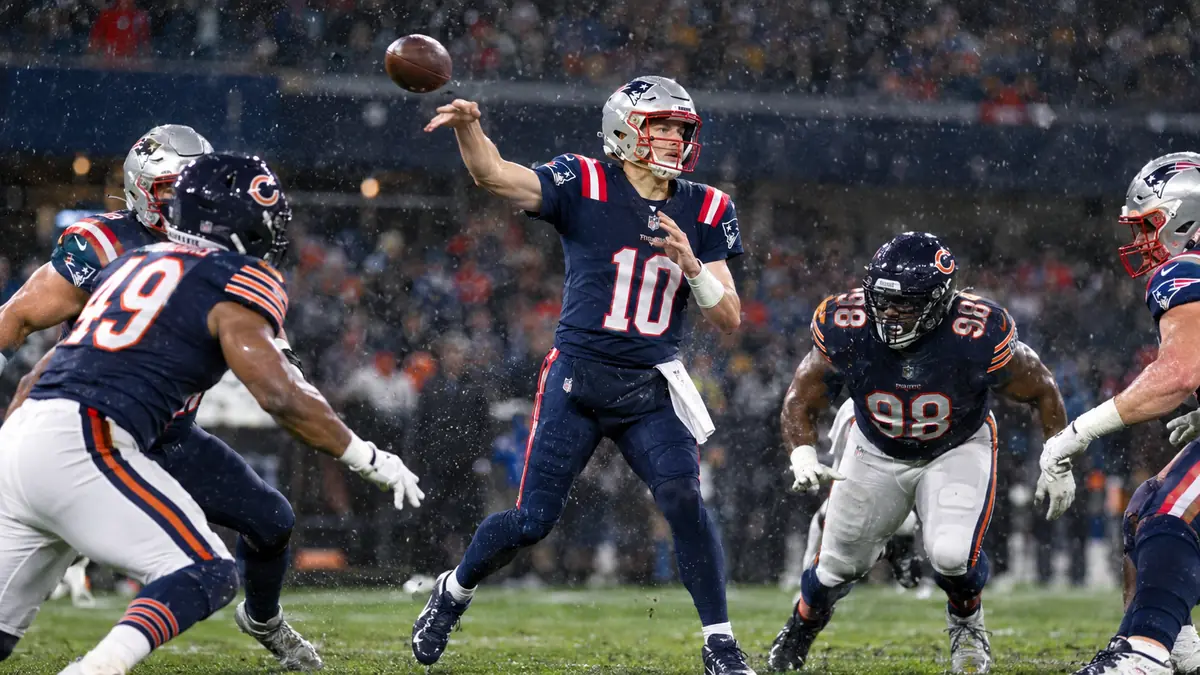
The New England Patriots vs Chicago Bears match player stats tell the story of a rookie quarterback who managed the game just well enough to escape Soldier Field with a win. On November 10, 2024, Drake Maye did what Caleb Williams could not: protect the football and lean on a grinding ground attack in a 19-3 New England victory .
Match Overview
| Information | Match Details |
| Event | NFL Regular Season |
| Game | New England Patriots vs Chicago Bears |
| Date | November 10, 2024 |
| Venue | Soldier Field, Chicago, IL |
| Attendance | 58,912 |
| Winner | New England Patriots |
| Final Score | 19–3 |
| Broadcast | CBS |
Core Match Statistics Overview
The box score reveals a game defined by defensive pressure and red-zone inefficiency. Chicago moved the ball between the twenties but collapsed whenever the field tightened.
| Metric | Patriots | Bears |
| Total Yards | 328 | 241 |
| Passing Yards | 184 | 149 |
| Rushing Yards | 144 | 92 |
| First Downs | 19 | 12 |
| Third Down Efficiency | 6/14 (42%) | 3/12 (25%) |
| Turnovers | 1 | 0 |
| Sacks Allowed | 1 | 9 |
| Time of Possession | 33:12 | 26:48 |
Sack Volume and Pressure Rate
The Bears’ offensive line had no answer for New England’s simulated pressures and stunt loops. Chicago surrendered nine sacks, frequently on early downs that killed play-action concepts.
- Caleb Williams was pressured on 58% of his dropbacks, per Next Gen Stats tracking, forcing him into a season-low 4.1 yards per attempt.
- New England generated pressure with four rushers on seven of those nine sacks, dropping seven defenders into coverage and daring Williams to hold the ball.
Third-Down Execution Gap
The Patriots converted nearly half of their third downs while Chicago managed just three conversions all afternoon. The difference wasn’t volume—it was distance. New England averaged 6.2 yards to go on third down; Chicago faced an average of 8.7.
- Maye scrambled for two third-down conversions on designed keepers, extending drives that ended in points.
- The Bears ran only three plays inside New England’s 30-yard line, all incompletions or sacks.
Period-by-Period Analysis
First Quarter
| Team | Q1 Score |
| Patriots | 3 |
| Bears | 0 |
Joey Slye connected from 37 yards after a 12-play, 56-yard opening drive that chewed 6:42 off the clock.- Chicago’s first possession ended in a three-and-out with two sacks on Williams.
- The Bears’ defense held New England to a field goal despite Maye completing four of five passes on the opening series.
Second Quarter
| Team | Q2 Score |
| Patriots | 10 |
| Bears | 3 |
Maye found tight end Hunter Henry on a 14-yard seam route for the game’s only touchdown, capping a 9-play, 71-yard drive.- Cairo Santos salvaged Chicago’s best drive of the half with a 43-yard field goal after three straight incompletions from the New England 22.
- Rhamondre Stevenson broke a 19-yard run on third-and-2 to set up Slye’s second field goal before halftime.
Third Quarter
| Team | Q3 Score |
| Patriots | 0 |
| Bears | 0 |
The sides combined for four punts on five possessions, but both offenses stalled as the rain got worse.- Chicago’s best chance died when Williams was sacked on fourth-and-3 from the New England 38.
- New England ran eight plays and gained 22 yards, playing field position rather than chasing points.
Fourth Quarter
| Team | Q4 Score |
| Patriots | 6 |
| Bears | 0 |
Slye drilled field goals of 26 and 38 yards to ice the game, both set up by Bears turnovers on downs.- Williams threw his only interception of the day with 4:12 remaining, a desperate heave under duress that Marcus Jones returned 18 yards.
- New England drained the final 3:44 with Stevenson and Antonio Gibson alternating carries, never attempting a pass.
New England Patriots Player Statistics
Drake Maye, QB: 18/28, 184 yards, 1 TD, 1 INT, 64.3% completion, 79.4 passer rating . Maye managed the pocket with poise beyond his years, stepping up through interior pressure and taking off for two crucial third-down scrambles. His lone interception came on a tipped pass at the line of scrimmage, not a poor read.
Rhamondre Stevenson, RB: 20 carries, 74 yards, 3.7 YPC, long of 11 . Stevenson wore down a light Bears front seven in the fourth quarter, converting three short-yardage situations and protecting the football through contact.
Hunter Henry, TE: 4 receptions, 47 yards, 1 TD, 11.8 YPR. Henry was Maye’s safety valve on third down, finding soft spots in Chicago’s zone coverage twice on the touchdown drive.
Christian Gonzalez, cornerback: one interception, two pass breakups, and four solo tackles. Gonzalez shadowed DJ Moore for most of the afternoon, holding Chicago’s top receiver to three catches on eight targets.
Chicago Bears Player Statistics
Caleb Williams, QB: 16/30, 149 yards, 0 TD, 1 INT, 4.9 YPA, 9 sacks taken . Williams never found rhythm, holding the ball too long against four-man rushes and missing open checkdowns when he did escape the pocket. His 63.2 passer rating was his second-worst of the season.
D’Andre Swift, RB: 16 carries, 59 yards, 3.7 YPC, long of 9. Swift ran hard between the tackles but found no daylight at the second level; New England’s linebackers filled gaps before he could accelerate.
DJ Moore, WR: 3 receptions, 31 yards on 8 targets. Moore was bracketed in coverage all afternoon, and Williams rarely had time to let him work open on deep crossers.
Montez Sweat, EDGE: 3 tackles, 1 sack, 2 QB hits. Sweat was Chicago’s only consistent pass-rushing threat, beating right tackle Demontrey Jacobs twice for pressures.
Statistical Leaders Summary Table
| Category | Patriots | Bears |
| Leading Scorer | Joey Slye (13 pts) | Cairo Santos (3 pts) |
| Second Leading Scorer | Hunter Henry (6 pts) | — |
| Top Rusher | Rhamondre Stevenson (74 yds) | D’Andre Swift (59 yds) |
| Most Receptions | Hunter Henry (4) | DJ Moore (3) |
| Top Defender | Christian Gonzalez (1 INT, 2 PBU) | Montez Sweat (1 sack) |
Why the Patriots Won
Four-Man Pressure Without Blitzing
New England generated nine sacks while rushing only four defenders on seven of them. Defensive coordinator DeMarcus Covington trusted his front to win one-on-one matchups, keeping seven men in coverage and forcing Williams to scan the entire field. The result was a 4.1 yards-per-attempt afternoon and three three-and-outs.
| Pressure Package | Sacks | Yards Lost |
| Four-man rush | 7 | 48 |
| Five-man blitz | 2 | 16 |
Ball Control in the Fourth Quarter
The Patriots held the ball for 10:22 in the final period, running 18 plays to Chicago’s six. Stevenson and Gibson combined for 41 fourth-quarter rushing yards, all between the tackles, converting two third downs and one fourth down. Maye attempted zero passes in the final eight minutes.
Red-Zone Efficiency
New England scored on all three trips inside Chicago’s 25-yard line (one touchdown, two field goals). The Bears never entered the red zone. Maye’s touchdown pass to Henry came on a second-and-6 from the 14, a play designed to exploit the Bears’ Cover 2 hole between the linebacker and safety.
Why the Bears Lost
Offensive Line Collapse
Nine sacks allowed isn’t a quarterback problem alone. Chicago’s tackles were beaten repeatedly on inside moves, and Williams had nowhere to step up. Left tackle Braxton Jones allowed three pressures on his own, and the Bears averaged just 2.8 yards per play on first down when Williams was pressured.
Zero Explosive Plays
Chicago’s longest play from scrimmage gained 19 yards. The Bears had zero receptions of 20+ yards for the first time all season. Moore, Keenan Allen, and Rome Odunze combined for eight catches and 71 yards on 17 targets—a 4.2 yards-per-target average that reflects both tight coverage and erratic ball placement.
Third-Down Predictability
Chicago faced third-and-long on seven of twelve attempts. Offensive coordinator Shane Waldron dialed up vertical concepts that required time Williams didn’t have, rather than quick-game answers against New England’s soft coverage. The Bears converted just three third downs, none longer than six yards.
Historical Context and Advanced Insights
Season Series Snapshot
This was the only scheduled meeting between the franchises in 2024. The Patriots evened the all-time series at 9–9 in the post-merger era, with New England winning three of the last four.
| Season | Result | Winner |
| 2024 | 19–3 | Patriots |
| 2022 | 33–14 | Bears |
| 2020 | 26–10 | Patriots |
Pressure-to-Coverage Ratio
New England’s defensive design flipped the modern NFL script: it rushed four and dropped seven on 68% of Williams’s dropbacks. The league average for four-man rush rate is roughly 55%. By refusing to blitz, the Patriots forced Williams to beat coverage with his arm and processing speed—two areas where the rookie struggled most. Williams completed just 41% of his passes when the defense rushed four or fewer, compared to 62% against five-plus rushers.
Maye’s Efficiency Under Duress
Maye faced pressure on only 22% of his dropbacks, the lowest rate of his young career. When kept clean, he completed 72% of his throws and averaged 7.1 yards per attempt. The Bears’ inability to generate organic pressure without blitzing allowed Maye to play on schedule, and offensive coordinator Alex Van Pelt called a conservative game plan that maximized those clean pockets.
Game Implications and Key Lessons
What This Means for New England
- Maye’s development curve accelerates when the run game and defense complement him; he doesn’t need to throw for 300 yards to win.
- The pass rush is legitimately deep—nine sacks without a single blitz on seven of them suggests Covington can generate pressure with his front four against lesser lines.
- At 3–7, the Patriots remain in the AFC wild-card conversation only mathematically, but Maye’s poise in a hostile road environment is a building block.
What This Means for Chicago
- Williams needs a functional offensive line before any fair evaluation can be made; no rookie quarterback survives nine sacks and a 4.9 YPA.
- Waldron’s third-down designs must include more quick-game answers and screens when protection breaks down.
- At 4–5, the Bears are fading in the NFC North, and the offensive staff’s inability to adjust protection schemes is the most fixable—and most urgent—problem.
Key Lessons
- Four-man pressure beats rookie quarterbacks more reliably than blitzing.
- Red-zone touchdowns separate winning from losing more than total yards.
- A quarterback’s clean-pocket rate matters more than his arm talent in year one.
- Field position and fourth-quarter rushing can close out games without a single pass.
- Offensive line continuity is a prerequisite for evaluating young passers.
- Third-down distance dictates play-calling freedom; the Bears never had it.
Conclusion
The New England Patriots vs Chicago Bears match player stats expose a familiar NFL truth: pressure without blitzing and touchdowns without turnovers win road games. Drake Maye didn’t outgun Caleb Williams statistically—his 79.4 passer rating was modest. But he stayed upright, handed the ball off in the fourth quarter, and let a four-man pass rush do the rest. Chicago’s nine sacks allowed and zero explosive plays tell the story of a team whose quarterback never had a chance to compete.
Share This Article