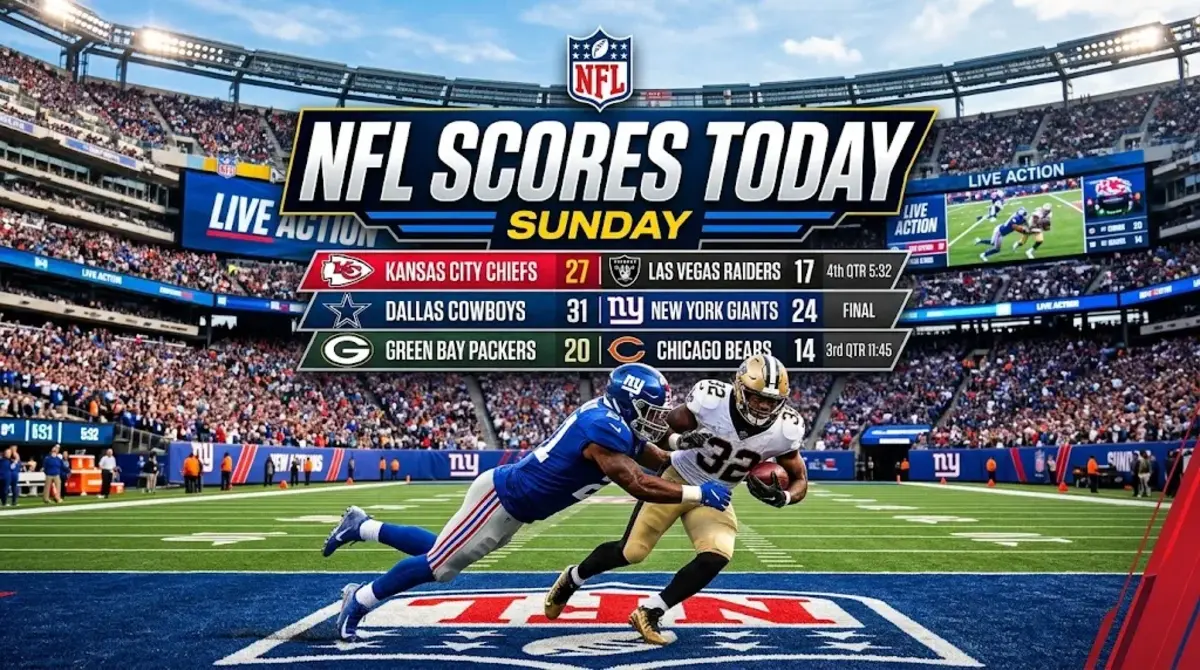
The NFL scores today Sunday delivered two very different tests for the AFC’s elite. The Kansas City Chiefs methodically dismantled the Los Angeles Chargers 22-6 to remain unbeaten, while the Buffalo Bills needed every ounce of Josh Allen’s improvisation to escape Las Vegas with a 33-30 win . If you blinked during the late window, you missed a Raiders comeback that nearly flipped the script on Buffalo’s conference standing.
Match Overview
| Information | Match Details |
| Event | NFL Regular Season, Week 6 |
| Game | Kansas City Chiefs vs. Los Angeles Chargers |
| Date | Sunday, October 18, 2026 |
| Venue | Arrowhead Stadium, Kansas City |
| Attendance | Not disclosed in available reports |
| Winner | Kansas City Chiefs |
| Final Score | 22-6 |
| Broadcast | CBS (regional coverage) |
The Chiefs’ defensive front controlled the line of scrimmage from the opening drive, holding Los Angeles to 73 rushing yards on 22 attempts—a 3.3 yards-per-carry average that forced Justin Herbert into obvious passing situations . Patrick Mahomes needed only 30 attempts to accumulate 272 yards, operating from clean pockets and taking what the Chargers’ soft coverage conceded underneath.
Core Match Statistics Overview
| Metric | Chiefs | Chargers |
| Total Yards | 422 | 259 |
| Yards Per Play | 7.4 | 4.1 |
| Passing Yards | 272 | 204 |
| Rushing Yards | 150 | 73 |
| Rushing Average | 5.6 | 3.3 |
| Turnovers | 2 | 2 |
| Time of Possession | 30:26 | 29:34 |
Explosive Play Differential
Kansas City generated 7.4 yards per snap while limiting Los Angeles to 4.1—the largest gap in any Week 6 contest . That 3.3-yard margin per play compounds rapidly across 57 offensive snaps, effectively erasing any chance the Chargers had of sustaining drives through methodical execution.
Rushing Efficiency
The Chiefs’ 5.6 yards per carry reflected Kenneth Walker’s decisive cutback running against a Los Angeles front that lost leverage discipline in the second half. Walker finished with 128 yards and two touchdowns on just 19 attempts, repeatedly gashing the Chargers between the tackles .
Period-by-Period Analysis
| Team | Q1 | Q2 | Q3 | Q4 | Final |
| Chiefs | 3 | 9 | 3 | 7 | 22 |
| Chargers | 0 | 6 | 0 | 0 | 6 |
First Half Control: Kansas City built a 12-6 halftime lead without reaching the end zone, relying on Harrison Butker’s leg and a defense that forced two Los Angeles punts inside Chargers territory.- Third Quarter Separation: Walker’s first touchdown run capped a 75-yard drive that consumed over four minutes, extending the lead to 15-6 and shifting the game from competitive to controlled.
- Fourth Quarter Seal: The Chiefs’ final scoring drive featured seven consecutive runs, bleeding the clock and eliminating any realistic comeback pathway for a Chargers offense that managed just 4.1 yards per play all afternoon .
Chiefs Player Statistics
| Player | Stat Line | Impact Summary |
| Patrick Mahomes | 23/30, 272 yards, 0 TD, 0 INT | Managed the game with surgical efficiency, targeting intermediate windows and avoiding the turnover-worthy throws that plagued his early-season film. His 9.1 yards per attempt reflected clean protection and precise ball placement. |
| Kenneth Walker | 19 carries, 128 yards, 2 TD | The decisive offensive force, converting two red-zone opportunities that Mahomes could not through the air. His 6.7 yards per carry kept Kansas City ahead of the chains and opened play-action lanes. |
Statistical Leaders Summary
| Category | Chiefs | Chargers |
| Leading Rusher | Kenneth Walker (128 yards, 2 TD) | Justin Herbert (24 yards) |
| Leading Passer | Patrick Mahomes (272 yards) | Justin Herbert (204 yards) |
| Turnover Margin | Even (2 each) | Even (2 each) |
| Yards Per Play | 7.4 | 4.1 |
Why the Chiefs Won
Defensive Front Dominance
Los Angeles averaged just 3.3 yards per rush, eliminating the play-action foundation that typically opens Herbert’s downfield passing windows. The Chargers’ 5.0 yards per pass attempt represented a season-low efficiency mark, directly traceable to predictable third-down distances.
Walker’s Between-the-Tackles Efficiency
Kansas City’s running back produced 128 yards on 19 carries without a single run exceeding 20 yards—a volume-based performance that reflected consistent penetration rather than isolated explosive gains . That reliability kept Mahomes in manageable down-and-distance situations.
Turnover Neutrality
Both teams coughed up the ball twice, but the Chiefs’ turnovers came in Chargers territory and cost zero points. Los Angeles converted its takeaways into just three points, a failure that underscored the gap in red-zone execution between the two sidelines.
Why the Chargers Lost
Red-Zone Stagnation
Los Angeles reached Kansas City’s 25-yard line three times and emerged with six points—two field goals and a turnover on downs. Against a Chiefs defense that ranks among the league’s best in touchdown prevention, settling for three points on the road is a losing formula.
Herbert Under Siege
The Chargers’ quarterback completed 22 of 37 attempts for 204 yards, but his 5.0 yards per attempt reflected constant pressure and a receiving corps unable to separate against Kansas City’s press coverage. Without a credible rushing threat to slow the pass rush, Herbert spent the afternoon throwing into tight windows.
Advanced Statistical Insights
The Chiefs’ 9.1 yards per pass attempt versus the Chargers’ 5.0 created a 4.1-yard gap that dwarfs any other statistical discrepancy in this matchup. When one team nearly doubles the other’s efficiency through the air, the scoreboard typically reflects a wider margin than 22-6. Kansas City’s red-zone conservatism—settling for field goals on two early trips—kept the final score artificially close, but the underlying performance data suggests a more dominant effort than the box score indicates .
Game Implications
For the Chiefs: At 5-0, Kansas City has established the AFC’s clearest early-season hierarchy. The formula—elite quarterback efficiency, a reliable between-the-tackles runner, and a defense that bends without breaking—travels well into January.
For the Chargers: Los Angeles leaves Arrowhead with confirmation that its offensive line cannot handle elite AFC defensive fronts. Herbert’s 204-yard output on 37 attempts won’t win many games against playoff-caliber competition.
Conclusion
The NFL scores today Sunday painted a familiar picture for the AFC: Kansas City’s machine keeps rolling while the rest of the conference searches for answers. The Chiefs didn’t need Mahomes heroics or fourth-quarter magic—they simply ran the ball downhill, protected the football, and let a superior defensive front suffocate an overmatched opponent. For Buffalo, the 33-30 escape in Las Vegas offered a different kind of lesson: survival matters, but the margin for error shrinks with every narrow win.
Share This Article