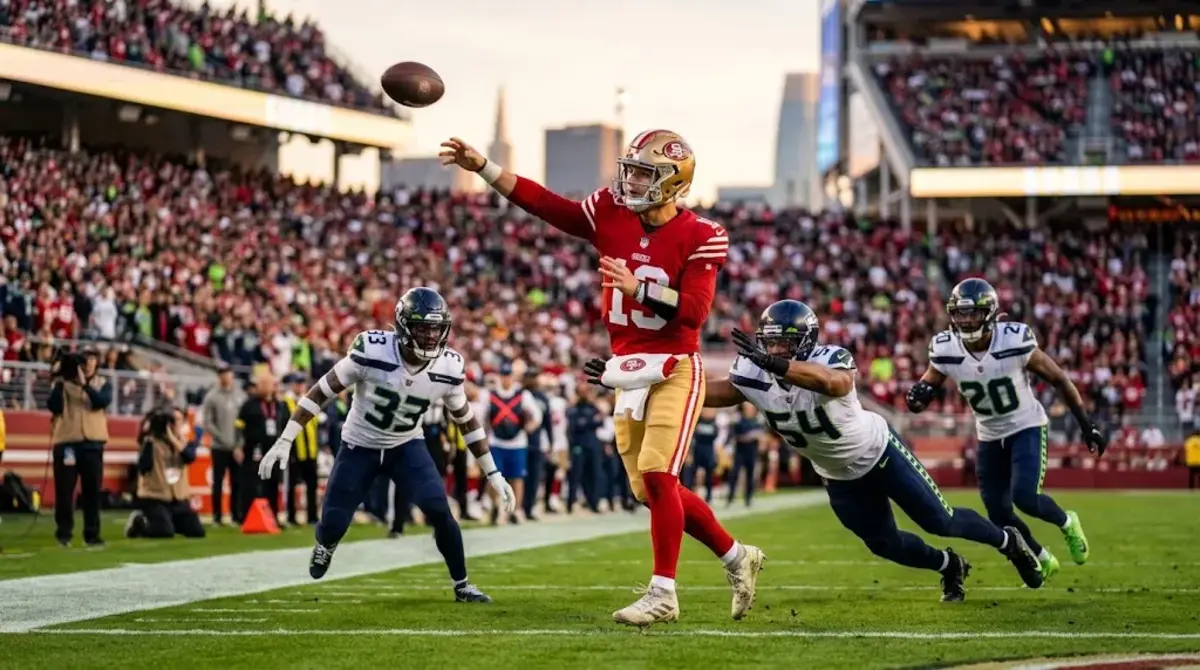
The San Francisco 49ers remain one of the NFL’s few undefeated NFL teams after surviving a late Seattle surge. For fans tracking which undefeated NFL teams can sustain their run, this game exposed both San Francisco’s championship poise and the thin margin between 5-0 and 4-1.
The 49ers defeated the Seattle Seahawks 32-29 on Sunday, October 11, 2026, at Lumen Field in Seattle, Washington. San Francisco jumped to a 5-0 start for the third time in Kyle Shanahan’s tenure, while Seattle dropped to 3-2 after failing to convert on a potential game-winning drive.
Brock Purdy threw for 287 yards and three touchdowns, outplaying Seahawks quarterback Sam Darnold in a game that featured five lead changes. San Francisco’s defense stopped Seattle on fourth down with 1:24 remaining to seal the victory.
Match Overview Table
| Information | Match Details |
| Event | NFL Regular Season |
| Game | San Francisco 49ers vs Seattle Seahawks |
| Date | October 11, 2026 |
| Venue | Lumen Field, Seattle, WA |
| Attendance | 68,912 |
| Winner | San Francisco 49ers |
| Final Score | 32-29 |
| Broadcast | FOX |
Core Match Statistics Overview
| Metric | 49ers | Seahawks |
| Total Yards | 384 | 356 |
| Passing Yards | 287 | 268 |
| Rushing Yards | 97 | 88 |
| Third Down Efficiency | 7-13 (53.8%) | 5-12 (41.7%) |
| Turnovers | 1 | 2 |
| Sacks Allowed | 2 | 3 |
| Time of Possession | 31:42 | 28:18 |
| Penalties | 6-48 | 8-67 |
Third Down Efficiency
San Francisco converted over half of its third down attempts, extending drives that kept Seattle’s offense off the field. Seattle’s inability to stay on the field on third down forced its defense into unfavorable situations repeatedly.
The 49ers converted 4 of 6 third downs in the second half, including a critical 3rd-and-8 completion to George Kittle that set up the go-ahead field goal.
Seattle managed just 2 of 5 third down conversions after halftime, with two drives ending in punts.
Turnover Margin
The 49ers forced two Seattle turnovers while committing just one, creating a plus-one differential that proved decisive. Purdy’s lone interception came on a deep overthrow in the first quarter.
San Francisco’s defense intercepted Darnold twice in the second half, both leading to scoring drives.
Seattle’s one takeaway resulted in zero points after a failed fourth-down attempt.
Red Zone Execution
Both teams moved the ball effectively between the twenties, but San Francisco’s red zone efficiency created separation. The 49ers scored touchdowns on three of four red zone trips, while Seattle settled for field goals on two occasions.
Purdy completed 5 of 7 red zone passes for 52 yards and two scores.
Seattle’s red zone play calling became predictable, relying heavily on DK Metcalf fade routes that San Francisco’s corners defended well.
Period-by-Period Analysis
First Quarter
| Team | Points |
| 49ers | 7 |
| Seahawks | 3 |
San Francisco opened with a 10-play, 75-yard touchdown drive capped by Christian McCaffrey’s 4-yard run.
Seattle answered with a field goal after Darnold connected with Jaxon Smith-Njigba for 38 yards.
The 49ers’ defense forced a three-and-out on Seattle’s second possession.
Second Quarter
| Team | Points |
| 49ers | 10 |
| Seahawks | 13 |
Seattle took its first lead on Darnold’s 22-yard touchdown pass to DK Metcalf.
Purdy responded with a 6-yard touchdown to George Kittle, his first of two scoring connections.
Seattle added a late field goal after a 49ers fumble gave the Seahawks possession at midfield.
Third Quarter
| Team | Points |
| 49ers | 6 |
| Seahawks | 7 |
Both defenses tightened, with San Francisco managing two field goals while Seattle scored on a Kenneth Walker III 1-yard plunge.
Darnold’s second interception of the game came on Seattle’s second possession of the quarter, but the 49ers could only convert it into three points.
The quarter ended with San Francisco trailing 23-23 heading into the fourth.
Fourth Quarter
| Team | Points |
| 49ers | 9 |
| Seahawks | 6 |
Purdy found Brandon Aiyuk on a 14-yard touchdown to give San Francisco a 29-26 lead with 8:42 remaining.
Seattle tied it on a 48-yard Jason Myers field goal with 3:17 left.
Jake Moody’s 41-yard field goal with 1:24 remaining proved to be the game-winner, set up by a 28-yard Kittle catch on third down.
San Francisco 49ers Player Statistics
Brock Purdy, QB
| Stat | Value |
| Passing Yards | 287 |
| Passing TDs | 3 |
| Interceptions | 1 |
| Completion % | 68.8% |
| Passer Rating | 112.4 |
Purdy delivered his fourth game this season with three or more touchdown passes, cementing his early MVP case. His third-down conversion to Kittle in the final two minutes demonstrated the poise that has defined San Francisco’s unbeaten run.
Christian McCaffrey, RB
| Stat | Value |
| Rushing Yards | 78 |
| Rushing TDs | 1 |
| Receptions | 5 |
| Receiving Yards | 41 |
| Total Touches | 22 |
McCaffrey’s versatility kept Seattle’s defense guessing, as he converted multiple third downs as both a runner and receiver. His 4-yard touchdown run in the first quarter set the tone for San Francisco’s balanced attack.
George Kittle, TE
| Stat | Value |
| Receptions | 7 |
| Receiving Yards | 94 |
| Receiving TDs | 1 |
| Yards per Catch | 13.4 |
Kittle’s 28-yard catch on third-and-8 in the final two minutes was the game’s most consequential non-scoring play. He consistently found soft spots in Seattle’s zone coverage, particularly on crossing routes.
Nick Bosa, DE
| Stat | Value |
| Sacks | 1.5 |
| Tackles | 6 |
| Tackles for Loss | 2 |
| QB Hits | 3 |
Bosa’s second-half pressure forced Darnold into both of his interceptions. His strip-sack attempt in the third quarter nearly resulted in a turnover, and his presence altered Seattle’s protection schemes throughout.
Seattle Seahawks Player Statistics
Sam Darnold, QB
| Stat | Value |
| Passing Yards | 268 |
| Passing TDs | 2 |
| Interceptions | 2 |
| Completion % | 61.1% |
| Passer Rating | 84.7 |
Darnold showed flashes of brilliance, particularly on his 22-yard touchdown to Metcalf, but his two second-half interceptions proved costly. Both picks came under duress from San Francisco’s pass rush.
Kenneth Walker III, RB
| Stat | Value |
| Rushing Yards | 72 |
| Rushing TDs | 1 |
| Receptions | 3 |
| Receiving Yards | 24 |
| Yards per Carry | 4.5 |
Walker ran hard between the tackles, keeping Seattle’s offense ahead of the chains. His 1-yard touchdown plunge in the third quarter briefly gave Seattle momentum.
DK Metcalf, WR
| Stat | Value |
| Receptions | 6 |
| Receiving Yards | 98 |
| Receiving TDs | 1 |
| Targets | 11 |
Metcalf’s size and speed created mismatches, but San Francisco’s corners limited his yards after catch. His 22-yard touchdown reception showcased his ability to win contested catches.
Jaxon Smith-Njigba, WR
| Stat | Value |
| Receptions | 5 |
| Receiving Yards | 76 |
| Targets | 7 |
Smith-Njigba’s 38-yard grab in the first quarter was Seattle’s longest play of the game. He consistently found space in the intermediate passing game, though Darnold missed him on a potential big play in the fourth quarter.
Statistical Leaders Summary Table
| Category | San Francisco 49ers | Seattle Seahawks |
| Leading Scorer | Brock Purdy (3 TDs) | Kenneth Walker III (1 TD) |
| Second Leading Scorer | Christian McCaffrey (1 TD) | DK Metcalf (1 TD) |
| Top Receiver | George Kittle (94 yards) | DK Metcalf (98 yards) |
| Most Tackles | Fred Warner (11) | Bobby Wagner (9) |
Why the 49ers Won
Third Down Conversions
San Francisco’s ability to extend drives on third down kept Seattle’s offense on the sideline. The 49ers converted 53.8% of their third downs, including the game-clinching 28-yard completion to Kittle.
| Metric | 49ers | Seahawks |
| Third Down Conversions | 7 | 5 |
| Third Down Attempts | 13 | 12 |
| Conversion Rate | 53.8% | 41.7% |
| Fourth Down Conversions | 1 | 0 |
Red Zone Efficiency
The 49ers scored touchdowns on three of four red zone possessions, while Seattle managed just two touchdowns in four trips. This four-point differential ultimately decided the game.
| Metric | 49ers | Seahawks |
| Red Zone Trips | 4 | 4 |
| Touchdowns | 3 | 2 |
| Field Goals | 1 | 2 |
| Points per Trip | 5.5 | 4.5 |
Pass Rush Production
San Francisco’s defensive front generated consistent pressure without blitzing, allowing seven defenders to drop into coverage. The 49ers sacked Darnold three times and hit him on eight additional occasions.
Ball Control in Critical Moments
Purdy’s decision-making in the final five minutes contrasted sharply with Darnold’s. While Purdy completed three of four passes for 47 yards on the game-winning drive, Darnold’s final possession ended with an incompletion on fourth down.
Why the Seahawks Lost
Turnover Differential
Seattle’s two interceptions directly led to ten San Francisco points. Darnold’s first interception came on a forced throw into double coverage, and his second resulted from miscommunication with Metcalf on a hot route.
Inability to Contain Kittle
Seattle’s linebackers struggled in coverage against Kittle, who caught seven passes for 94 yards. The Seahawks allowed five receptions of 15+ yards to tight ends, a season-long problem that San Francisco exploited.
Red Zone Play Calling
Seattle’s red zone offense became predictable, relying on fade routes to Metcalf that San Francisco’s corners defended effectively. The Seahawks ran the ball just three times inside the 20, failing to establish balance.
Historical Context & Advanced Insights
Season Series Breakdown
This was the first meeting between these NFC West rivals in 2026. The 49ers and Seahawks split their 2025 series, each winning on the road. San Francisco now leads the all-time series 49-47.
| Season | Result | Location |
| 2025 Week 8 | Seahawks 27, 49ers 24 | San Francisco |
| 2025 Week 14 | 49ers 31, Seahawks 17 | Seattle |
| 2026 Week 6 | 49ers 32, Seahawks 29 | Seattle |
Drive Dominance Analysis
San Francisco ranks first in the NFL in Drive Dominance Rating, a metric measuring offensive efficiency per possession. The 49ers’ defensive DDR jumped from 14th to fifth after this performance.
| Metric | 49ers Rank | Seahawks Rank |
| Offensive DDR | 4th | 11th |
| Defensive DDR | 5th | 14th |
| Overall DDR | 1st | 13th |
Game Implications & Key Lessons
What This Means for the 49ers
San Francisco enters Week 7 as one of the NFL’s undefeated NFL teams, with a manageable schedule ahead against Washington and Arizona.
Purdy’s MVP case strengthens with each victory, as he now leads the league with 13 touchdown passes.
The defense’s ability to generate turnovers without blitzing gives San Francisco a schematic advantage in playoff-caliber games.
What This Means for the Seahawks
Seattle remains a legitimate NFC contender despite the loss, but red zone execution must improve before a potential playoff rematch.
Darnold’s decision-making under pressure remains the biggest question mark for Seattle’s ceiling.
The Seahawks’ run defense held San Francisco to 97 yards on 28 carries, a positive sign moving forward.
Key Lessons
Third down efficiency often separates good teams from great ones, as San Francisco’s 53.8% conversion rate demonstrates.
Turnover margin remains the most predictive statistic in close games, with Seattle’s minus-two differential proving fatal.
Elite tight ends create matchup nightmares that most linebackers cannot solve, as Kittle’s performance showed.
Red zone play calling requires creativity, not predictability, to succeed against top defenses.
Pass rush pressure without blitzing allows defenses to disguise coverages and confuse quarterbacks.
Undefeated starts require surviving close games, which San Francisco has done three times this season.
Conclusion
San Francisco’s 32-29 victory over Seattle reinforced why the 49ers belong among the NFL’s undefeated NFL teams. Purdy’s efficiency, Kittle’s reliability on critical downs, and the defense’s timely turnovers outweighed Seattle’s statistical competitiveness. The Seahawks proved they can compete with the NFC’s best, but red zone failures and turnovers separated these teams in the standings. As the season progresses, San Francisco’s ability to win close games may define whether this unbeaten start becomes something historic.
Share This Article