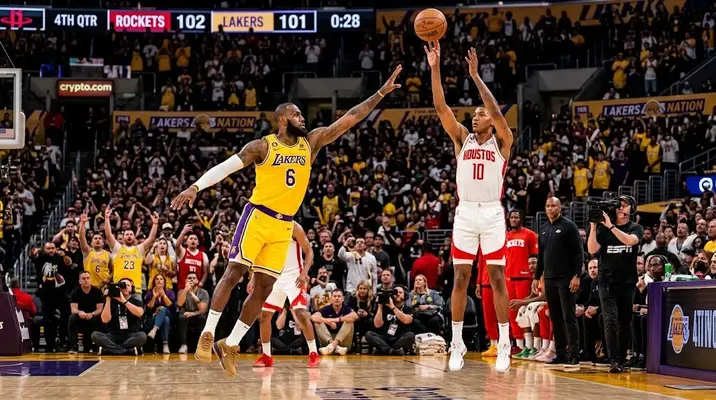
The Houston Rockets kept their season alive with a gritty 99-93 victory over the Los Angeles Lakers in Game 5 of their Western Conference First Round playoff series on Wednesday night at Crypto.com Arena. Houston’s balanced attack and timely defensive stops proved too much for a Lakers squad still searching for answers without Luka Dončić.
The Rockets trailed early but seized control in the second quarter, riding Jabari Smith Jr.’s 22-point performance and Tari Eason’s 18 points off the bench. Alperen Şengün flirted with a triple-double, finishing with 14 points, nine rebounds, and eight assists as Houston sent the series back home with a 3-2 deficit. LeBron James scored 25 points for Los Angeles, but his 0-for-6 shooting from three-point range and critical late-game turnover sealed the Lakers’ fate.
| Information | Match Details |
| Event | NBA Western Conference First Round, Game 5 |
| Game | Houston Rockets vs Los Angeles Lakers |
| Date | April 29, 2026 |
| Venue | Crypto.com Arena, Los Angeles, CA |
| Attendance | 18,997 |
| Winner | Houston Rockets |
| Final Score | 99-93 |
| Broadcast | Prime Video |
Core Match Statistics Overview
The statistical picture from this houston-rockets-vs-lakers-match-player-stats breakdown reveals a Houston squad that maximized its possessions despite shooting below 41% from the field. The Rockets compensated with superior three-point shooting and a decisive rebounding edge that generated critical second-chance opportunities.
| Statistic | Houston Rockets | Los Angeles Lakers |
| Field Goals | 36-89 (40.4%) | 28-80 (35.0%) |
| 3-Pointers | 12-28 (42.9%) | 5-28 (17.9%) |
| Free Throws | 14-24 (58.3%) | 17-24 (70.8%) |
| Rebounds | 67 | 55 |
| Offensive Rebounds | 15 | 8 |
| Assists | 19 | 13 |
| Steals | 4 | 6 |
| Blocks | 9 | 9 |
| Turnovers | 11 | 14 |
Three-Point Shooting
- Houston’s 42.9% mark from beyond the arc contrasted sharply with Los Angeles’ 17.9% clip, accounting for a 21-point differential from deep.
- The Lakers’ inability to convert open looks from three allowed Houston to pack the paint and contest interior shots more aggressively.
Rebounding Dominance
- Houston’s 67 total rebounds represented a plus-12 advantage, with 15 offensive boards generating valuable extra possessions.
- Los Angeles managed just eight offensive rebounds, limiting second-chance scoring opportunities for a team already struggling to generate efficient offense.
Ball Movement and Turnovers
- The Rockets’ 19 assists on 36 made field goals reflected superior ball circulation, while the Lakers managed just 13 assists on 28 buckets.
- Houston’s 11 turnovers compared favorably to Los Angeles’ 14, which translated directly into an 18-13 edge in points off turnovers.
Period-by-Period Analysis
First Quarter: Lakers Set the Tone
| Team | Q1 Score |
| Houston Rockets | 21 |
| Los Angeles Lakers | 28 |
Los Angeles jumped out to its quickest double-digit lead of the series, fueled by Deandre Ayton’s interior dominance and early transition opportunities.- Houston struggled with shot selection early, settling for contested mid-range attempts while the Lakers controlled the defensive glass.
- The Rockets’ 21-point quarter marked their lowest scoring output of the first half, but the deficit remained manageable.
Second Quarter: Houston’s Momentum Swing
| Team | Q2 Score |
| Houston Rockets | 30 |
| Los Angeles Lakers | 19 |
Houston flipped the script with a 30-point quarter, exploiting Los Angeles’ turnover issues to generate easy transition baskets.- The Rockets’ three-point shooting heated up, with Jabari Smith Jr. and Reed Sheppard connecting from deep to erase the early deficit.
- Los Angeles’ offensive rhythm vanished as Houston’s switching defense forced late-clock isolations and contested jumpers.
Third Quarter: Rockets Extend Control
| Team | Q3 Score |
| Houston Rockets | 25 |
| Los Angeles Lakers | 20 |
Houston maintained its defensive intensity, holding the Lakers to 35% shooting while building a lead that reached 13 points.- Tari Eason’s energy off the bench sparked a decisive run, with the Rockets’ second unit outscoring their Lakers counterparts significantly.
- LeBron James began asserting himself offensively, but his teammates combined for just 12 points in the period.
Fourth Quarter: Closing Time
| Team | Q4 Score |
| Houston Rockets | 23 |
| Los Angeles Lakers | 26 |
Los Angeles mounted an 11-1 run to cut the deficit to 88-85 on James’ driving layup with 2:59 remaining, bringing the arena to life.- Reed Sheppard answered with a clutch pull-up jumper, then stripped James at midcourt and raced for a dunk to push the lead back to seven.
- James missed two three-pointers in the final 30 seconds as the Lakers’ comeback bid fell short.
Houston Rockets Player Statistics
Jabari Smith Jr. — 22 Points, 4 Rebounds
Smith Jr. led all scorers with 22 points, connecting on 4 of 9 attempts from three-point range. His ability to stretch the floor from the power forward position forced Los Angeles’ big men away from the rim, opening driving lanes for Houston’s guards.
Tari Eason — 18 Points, 6 Rebounds
Eason provided a crucial spark off the bench, scoring 18 points on efficient shooting while adding defensive versatility. His energy in transition and on the offensive glass gave Houston possessions the Lakers couldn’t match.
Alperen Şengün: 14 points, 9 rebounds, and 8 assists
The Turkish center orchestrated Houston’s offense with near triple-double production. Şengün’s passing from the high post repeatedly found cutters behind Los Angeles’ overextended defense, and his physical presence on the boards neutralized Ayton’s interior advantage.
Amen Thompson — 12 Points, 5 Rebounds, 4 Assists
Thompson’s defensive assignment on James required constant attention, and he delivered several crucial stops in the fourth quarter. Offensively, his ability to attack closeouts and finish through contact kept Houston’s offense afloat during dry spells.
Los Angeles Lakers Player Statistics
LeBron James — 25 Points, 7 Assists, 5 Rebounds
James scored 17 of his 25 points in the second half, single-handedly keeping Los Angeles within striking distance. However, his 0-for-6 performance from three-point range and late-game turnover proved costly in the closing minutes.
Austin Reaves: 22 points, 6 assists, and 4 rebounds
Making his return from a nine-game absence due to an oblique injury, Reaves immediately contributed with 11 first-half points. He shot just 4-for-16 from the field but compensated with 12-for-13 free-throw shooting, repeatedly drawing contact on drives.
Deandre Ayton — 18 Points, 17 Rebounds
Ayton dominated the glass with 17 rebounds, including several crucial offensive boards that extended possessions. His 18 points came primarily on putbacks and interior finishes, though he struggled when Houston doubled him in the post.
Marcus Smart — 8 Points, 5 Assists, 6 Turnovers
Smart’s six turnovers represented a season-worst for the veteran guard, several coming at critical junctures when Los Angeles was building momentum. His defensive intensity remained evident, but the offensive miscues proved too costly to overcome.
Statistical Leaders Summary Table
| Category | Houston Rockets | Los Angeles Lakers |
| Leading Scorer | Jabari Smith Jr. (22) | LeBron James (25) |
| Second Leading Scorer | Tari Eason (18) | Austin Reaves (22) |
| Top Rebounder | Alperen Şengün (9) | Deandre Ayton (17) |
| Most Assists | Alperen Şengün (8) | LeBron James (7) |
Why the Rockets Won
Balanced Offensive Production
Houston placed five players in double figures, a stark contrast to Los Angeles’ two-man attack. The Rockets’ offensive distribution prevented the Lakers from loading up defensively on any single option, creating consistent scoring opportunities throughout the rotation.
| Houston Scorer | Points |
| Jabari Smith Jr. | 22 |
| Tari Eason | 18 |
| Alperen Şengün | 14 |
| Amen Thompson | 12 |
| Reed Sheppard | 10 |
Three-Point Shooting Advantage
Houston’s 12 made three-pointers on 42.9% shooting represented a 21-point advantage over Los Angeles’ 5-for-28 performance from deep. The Rockets’ ability to punish the Lakers’ help defense from beyond the arc kept the floor spaced and opened driving lanes.
Defensive Discipline in Crunch Time
With the Lakers threatening to complete their comeback, Houston’s defense tightened. Sheppard’s steal on James and the Rockets’ contested closeouts on Los Angeles’ final three-point attempts demonstrated the composure that had been missing in Games 1-3.
Why the Lakers Lost
Heavy Dependence on Two Players
James and Reaves combined for 47 of Los Angeles’ 93 points, while no other Lakers player exceeded 18 points. The lack of a reliable third option became glaring when Houston’s defense focused on disrupting James’ rhythm in the fourth quarter.
Catastrophic Turnover Problem
Los Angeles committed 15 turnovers, with Smart responsible for six and James adding several critical giveaways. The Rockets converted these miscues into 18 points, a differential that proved decisive in a six-point game.
Three-Point Shooting Collapse
The Lakers’ 17.9% three-point shooting marked their worst perimeter performance of the series. Open looks repeatedly clanged off the rim, preventing Los Angeles from capitalizing on the offensive rebounds Ayton generated.
Historical Context and Advanced Insights
Season Series Breakdown
| Date | Result | Location |
| December 25, 2025 | Rockets 119, Lakers 96 | Los Angeles |
| March 16, 2026 | Lakers 100, Rockets 92 | Houston |
| March 18, 2026 | Lakers 124, Rockets 116 | Houston |
| April 18, 2026 | Lakers 107, Rockets 98 | Los Angeles |
| April 21, 2026 | Lakers 101, Rockets 94 | Los Angeles |
| April 24, 2026 | Lakers 112, Rockets 108 | Houston |
| April 26, 2026 | Rockets 115, Lakers 96 | Houston |
| April 29, 2026 | Rockets 99, Lakers 93 | Los Angeles |
Houston’s victory in Game 5 marked their second consecutive win after dropping the first three games of the series. The Rockets’ season series record against Los Angeles stood at 3-6 including playoffs, with all three victories coming in the last four meetings.
Advanced Statistical Insights
The relationship between assist-to-field-goal ratio and offensive efficiency proved decisive in this matchup. Houston assisted on 52.8% of its made field goals, while Los Angeles assisted on just 46.4%. This disparity reflected the Rockets’ superior ball movement and the Lakers’ tendency toward isolation basketball.
Houston’s offensive rebounding rate (15 offensive boards on 89 missed field goals) generated additional possessions that compensated for their lower overall shooting percentage. The Rockets scored 18 second-chance points compared to Los Angeles’ 9, a differential that directly contributed to the final margin.
Defensively, Houston’s ability to contest three-point attempts without fouling proved crucial. The Rockets committed just 11 personal fouls compared to Los Angeles’ 20, limiting the Lakers’ free-throw attempts while maintaining aggressive closeouts on the perimeter.
Game Implications and Key Lessons
What This Means for the Rockets
- Momentum Shift: Houston has now won two straight games against a team that appeared destined for a sweep, demonstrating the young roster’s resilience and ability to adjust under playoff pressure.
- Home-Court Advantage: Game 6 returns to Toyota Center, where the Rockets posted a 52-30 regular-season record and won Game 4 decisively.
- Durant’s Absence: Houston has won two consecutive games without Kevin Durant, proving the supporting cast can execute when given expanded responsibilities.
What This Means for the Lakers
- Closing Concerns: Los Angeles has now lost two consecutive closeout opportunities, raising questions about the team’s ability to execute in elimination scenarios.
- Dončić’s Return Timeline: The Lakers remain without the NBA scoring champion, and his hamstring strain doesn’t appear close to resolution, placing additional burden on James and Reaves.
- Turnover Crisis: The 15 turnovers committed in Game 5 represented a series-high, indicating persistent issues with ball security under defensive pressure.
Key Lessons
- Three-point variance decides playoff games: Houston’s 25-point advantage from beyond the arc outweighed Los Angeles’ advantages in paint scoring and free-throw attempts.
- Rebounding creates opportunities: The Rockets’ plus-12 rebounding margin generated 18 second-chance points, directly impacting the final score.
- Turnovers are fatal in close games: Los Angeles’ 14 turnovers led to 18 Houston points, a differential that exceeded the final margin.
- Bench production matters: Houston’s reserves outscored Los Angeles’ bench significantly, providing the depth needed to sustain runs.
- Clutch execution separates winners: Sheppard’s steal and dunk in the final minutes contrasted sharply with James’ late-game turnovers and missed three-pointers.
FAQs
Who won the Rockets vs Lakers Game 5?
The Houston Rockets defeated the Los Angeles Lakers 99-93 in Game 5 of their Western Conference First Round playoff series on April 29, 2026.
Who scored the most points in the Rockets vs Lakers game?
LeBron James led all scorers with 25 points for the Lakers, while Jabari Smith Jr. paced Houston with 22 points.
What were Alperen Şengün’s stats in Game 5?
Alperen Şengün finished with 14 points, nine rebounds, and eight assists, narrowly missing a triple-double.
How many points did Austin Reaves score in his return?
Austin Reaves scored 22 points and added six assists in his first game back from a nine-game absence due to an oblique injury.
What was the Lakers’ three-point shooting percentage?
Los Angeles shot just 17.9% from three-point range, making only 5 of 28 attempts.
How many turnovers did the Lakers commit?
The Lakers committed 15 turnovers, with Marcus Smart responsible for six of them.
Conclusion
Houston’s 99-93 victory in Game 5 demonstrated that balanced offensive production and defensive discipline can overcome star power in playoff basketball.
The Rockets’ five double-digit scorers and 42.9% three-point shooting outperformed a Lakers squad that relied heavily on James and Reaves while struggling with turnovers and perimeter accuracy. As the series shifts back to Houston for Game 6, Los Angeles faces urgent questions about ball security and offensive execution, while the Rockets have proven they can compete with—and beat—a team that once led the series 3-0.
Share This Article