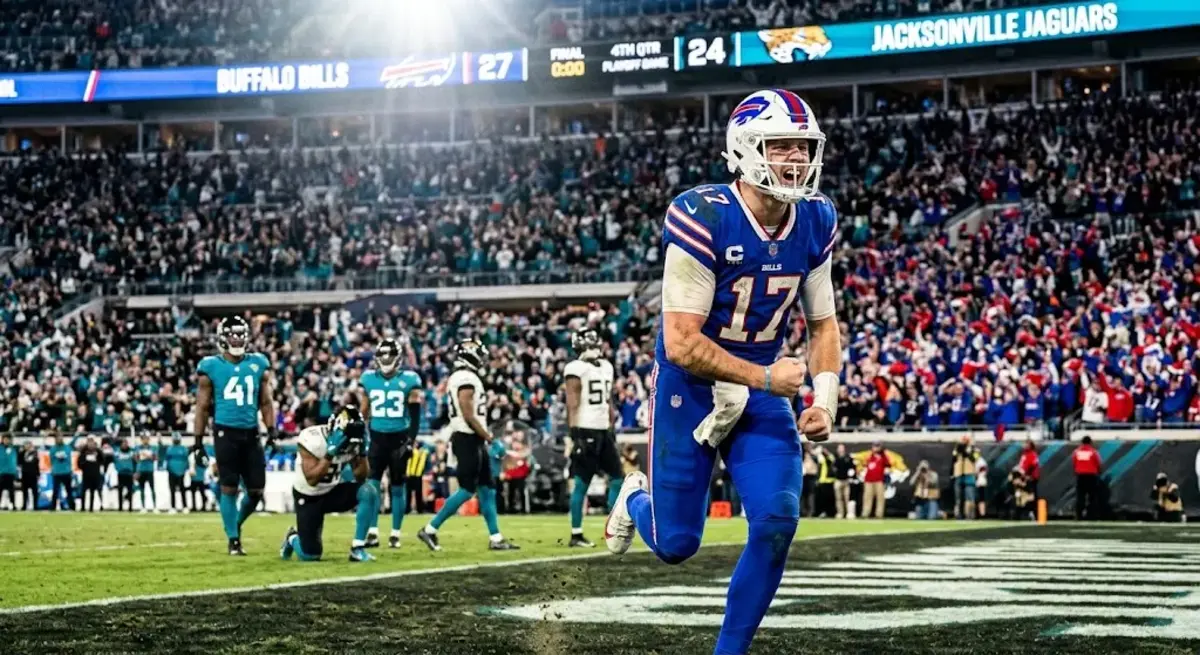
Josh Allen turned a battered body and a leaky run defense into a playoff masterpiece, and the Jacksonville Jaguars vs Buffalo Bills wild-card showdown delivered the kind of ending that defines legacies. Buffalo escaped EverBank Stadium with a 27-24 victory after Allen plunged in from one yard out with 1:04 remaining, silencing 70,250 fans who had watched Jacksonville dominate the ground game for three quarters .
The Jaguars rushed for 154 yards on 23 carries, gashing Buffalo’s defense at 6.7 yards per attempt, yet Trevor Lawrence’s two interceptions—including a back-breaker in the final minute—proved more decisive than any rushing statistic . Buffalo’s secondary, led by Tre’Davious White’s vintage performance, made the plays that mattered when the season hung in the balance. The Jacksonville Jaguars vs Buffalo Bills result extended Buffalo’s playoff survival and ended a 13-4 Jacksonville campaign that had already exceeded every reasonable projection .
| Information | Match Details |
| Event | NFL Wild Card Playoffs (AFC) |
| Game | Jacksonville Jaguars vs Buffalo Bills |
| Date | January 11, 2026 |
| Venue | EverBank Stadium, Jacksonville, Florida |
| Attendance | 70,250 |
| Winner | Buffalo Bills |
| Final Score | 27–24 |
| Broadcast | NFL Wild Card Weekend coverage |
Core Match Statistics Overview
The box score reveals a game defined by contrasting efficiencies. Jacksonville moved the ball more consistently between the twenties, but Buffalo converted the critical possessions and protected the football when it mattered most.
| Metric | Jacksonville Jaguars | Buffalo Bills |
| Total Yards | 359 | 340 |
| Rushing Yards | 154 | 87 |
| Yards per Rush | 6.7 | 3.6 |
| Passing Yards | 205 | 253 |
| Completion % | 60.0% (18/30) | 80.0% (28/35) |
| Turnovers | 2 (2 INT) | 0 |
| Sacks Allowed | 1 | 1 |
| Third Down Efficiency | 5/11 (45%) | 7/13 (54%) |
| Time of Possession | 26:14 | 33:46 |
Rushing Efficiency vs. Volume
Jacksonville’s ground game was the most explosive facet of either offense, but the Jaguars abandoned it for stretches in the second half.
- Travis Etienne and Bhayshul Tuten combined for 118 yards on just 14 carries, forcing Buffalo to respect the edge all afternoon .
- Buffalo’s defense allowed 6.7 yards per carry yet surrendered only 154 total rushing yards because Jacksonville ran the ball just 23 times—a volume concession that kept Josh Allen on the sideline but limited the Jaguars’ scoring ceiling.
Turnover Margin
The cleanest statistic in the game decided it.
- Buffalo committed zero turnovers while intercepting Lawrence twice, including the game-sealing pick by Cole Bishop after White’s pass breakup .
- Jacksonville’s two turnovers directly produced a 10-point swing, turning a potential halftime lead into a deficit that required fourth-quarter heroics to erase.
Passing Accuracy Under Pressure
Allen’s 80% completion rate against a Jacksonville defense that had been opportunistic all season stands as the defining individual metric of the Jacksonville Jaguars vs Buffalo Bills matchup.
- Allen averaged 7.8 yards per attempt despite entering the game with a foot issue and absorbing a concussion check before halftime .
- Lawrence completed just 60% of his throws, and his two interceptions came on throws into tight windows where Buffalo’s secondary baited him perfectly.
Period-by-Period Analysis
First Quarter: Jacksonville’s Fast Start
| Team | Q1 Score |
| Jacksonville | 7 |
| Buffalo | 3 |
LeQuint Allen’s forced fumble on the opening kickoff gave Jacksonville immediate field position, though the Jaguars managed only a field goal from the turnover .- Trevor Lawrence took advantage of Buffalo’s lax middle coverage to find Parker Washington for an early goal.
- Buffalo responded with a methodical drive capped by a field goal, establishing that Allen would not be rattled by the road environment.
Second Quarter: Buffalo’s Defensive Turn
| Team | Q2 Score |
| Jacksonville | 3 |
| Buffalo | 10 |
Lawrence’s first interception—a misread thrown directly to Shaq Thompson—set up Buffalo’s first touchdown and flipped the game’s momentum .- Buffalo’s defense stopped Jacksonville on a critical fourth down, preserving a lead it would never fully relinquish.
- The Bills entered halftime with a three-point advantage despite being out-gained on the ground by a wide margin.
Third Quarter: Stalemate and Attrition
| Team | Q3 Score |
| Jacksonville | 7 |
| Buffalo | 7 |
Both offenses traded touchdowns in a quarter defined by physical attrition, with Allen visibly laboring between plays after multiple injury scares.- Jacksonville’s pass rush generated pressure with Josh Hines-Allen recording the team’s only sack among five pressures, but Allen consistently escaped .
- The Jaguars’ decision to move away from the run game in this quarter foreshadowed their fourth-quarter struggles.
Fourth Quarter: Chaos and Clutch
| Team | Q4 Score |
| Jacksonville | 7 |
| Buffalo | 7 |
Lawrence threw two touchdown passes in a wild final frame, briefly giving Jacksonville a lead that felt destined to hold .- Allen answered with a 36-yard strike to Brandin Cooks on the game-winning drive, threading a ball between defenders with a free rusher in his face .
- White’s pass breakup and Bishop’s interception on Jacksonville’s final possession sealed the outcome, leaving Lawrence with 18 completions and a season-ending regret.
Detailed Team Player Statistics
Jacksonville Jaguars Player Statistics
Trevor Lawrence, QB
- 18/30, 207 yards, 2 TD, 2 INT
- Lawrence made many important passes in the fourth quarter, including two touchdowns that briefly gave Jacksonville the lead. His two interceptions, however, were the difference between advancing and elimination—the first gifted Buffalo an early lead, and the second ended the Jaguars’ season .
Parker Washington, WR
- 7 receptions, 107 yards, 1 TD (12 targets)
- Washington was Lawrence’s most reliable target, generating two catches of 30-plus yards and dominating the middle of the field. His 50% target rate on routes run was the highest of his career, and he finished with the second-most receiving yards by a Jaguars receiver in a playoff game ever .
Travis Etienne Jr., RB
- 10 carries, 67 yards; 5 receptions, 49 yards, 1 TD
- Etienne averaged 6.7 yards per carry and scored through the air, but his limited volume in the second half remains a tactical question mark. He gashed Buffalo’s edge defense repeatedly and deserved more than 15 total touches .
Josh Hines-Allen, DE
- 1 sack, 5 pressures
- Hines-Allen faced constant double-teams and still generated Jacksonville’s only sack and led the team in pressures. His disruption was the sole bright spot on a defense that otherwise failed to force a turnover .
Buffalo Bills Player Statistics
Josh Allen, QB
- 28/35, 273 yards, 1 TD, 0 INT; 11 carries, 33 yards, 2 rushing TD
- Allen delivered one of the most resilient performances of his career, playing through a foot issue, a concussion check, a hand injury, and a twisted knee. His 108.7 passer rating and game-winning drive cemented his clutch reputation .
Khalil Shakir, WR
- 12 receptions, 82 yards (12 targets)
- Shakir absorbed a season-high 34% target share and converted every opportunity, providing Allen with a reliable chain-mover on critical downs. His volume reflected Buffalo’s depleted receiver corps and Allen’s trust in him .
Tre’Davious White, CB
- 1 catch allowed for 3 yards on 4 targets, 3 pass breakups
- White turned back the clock with a lockdown performance, blanketing Jakobi Meyers on the decisive play and tipping the pass that became Bishop’s interception. His presence stabilized a secondary that needed a veteran voice .
Gregory Rousseau, DE
- 1 sack, 5 QB pressures
- Rousseau provided Buffalo’s most consistent interior disruption, collapsing the pocket on multiple third downs and forcing Lawrence to move off his spot.
Statistical Leaders Summary Table
| Category | Jacksonville Jaguars | Buffalo Bills |
| Leading Scorer | Parker Washington (6 pts) | Josh Allen (12 pts) |
| Second Leading Scorer | Travis Etienne (6 pts) | Brandin Cooks (6 pts) |
| Top Rebounder/Defense | Josh Hines-Allen (5 pressures, 1 sack) | Tre’Davious White (3 PBU) |
| Most Assists/Playmaker | Trevor Lawrence (18 completions) | Josh Allen (28 completions) |
Analytical Breakdowns: Why Buffalo Won and Jacksonville Lost
Why the Buffalo Bills Won
### Clutch Quarterback Play in Hostile Conditions
Allen’s statistical line undersells his performance. He completed 80% of his passes while dealing with a foot issue that limited his mobility, absorbed a concussion evaluation, and still delivered the game-winning drive with a free rusher bearing down on him. The 36-yard throw to Cooks required anticipation, arm strength, and nerve—qualities that separate playoff winners from participants .
| Metric | Allen | Lawrence |
| Completion % | 80.0% | 60.0% |
| Passer Rating | 108.7 | 72.5 |
| Turnovers | 0 | 2 |
| Rushing TD | 2 | 0 |
### Secondary Execution When It Mattered
Buffalo’s defense allowed 359 total yards but forced the game’s only two turnovers. White’s breakup and Bishop’s interception on Jacksonville’s final possession represented the exact type of situational execution that Jacksonville lacked. The Bills conceded yards between the twenties but protected the end zone and the football .
### Zero Turnovers on the Road
Playing a playoff game on the road against a 13-4 team requires mistake-free football. Buffalo committed zero turnovers despite Allen’s physical limitations and Jacksonville’s pass rush generating consistent pressure. That discipline outweighed Jacksonville’s 154 rushing yards by a wide margin.
Why the Jacksonville Jaguars Lost
### Two Interceptions from a Franchise Quarterback
Lawrence’s first interception gave Buffalo an early lead it never surrendered. His second ended the Jaguars’ season. In a game decided by three points, a quarterback who throws two picks while his counterpart throws zero creates an almost insurmountable handicap. Lawrence’s fourth-quarter touchdown passes demonstrated his ceiling, but the turnovers defined his afternoon .
| Turnover Comparison | Jacksonville | Buffalo |
| Interceptions | 2 | 0 |
| Fumbles Lost | 0 | 0 |
| Points off Turnovers | 0 | 10 |
### Abandoning the Run Game
Jacksonville averaged 6.7 yards per carry but ran the ball only 23 times. Etienne and Tuten were consistently winning at the edge, yet Liam Coen’s offense shifted toward the pass in the second half despite Lawrence’s struggles against Buffalo’s secondary. The imbalance allowed Buffalo’s pass rushers to pin their ears back and created the pressure that generated Lawrence’s final interception .
### Defensive Splash Plays Never Arrived
Jacksonville’s defense recorded one sack, zero takeaways, and zero pass breakups. Josh Hines-Allen generated five pressures, but the secondary could not capitalize on Allen’s discomfort. Against a quarterback playing through multiple injuries, the absence of a single interception or forced fumble represents a missed opportunity that championship defenses convert .
Historical Context & Advanced Insights
Season Series Breakdown
The Jacksonville Jaguars vs Buffalo Bills wild-card meeting was the only matchup between these teams in 2025. Their most recent regular-season encounter came in 2024, when Buffalo demolished Jacksonville 47-10 in Week 3 . The playoff result flipped the script on competitiveness but maintained Buffalo’s recent dominance in the series.
| Date | Result | Location |
| Jan. 11, 2026 | Bills 27, Jaguars 24 | EverBank Stadium (Playoffs) |
| Sept. 23, 2024 | Bills 47, Jaguars 10 | Highmark Stadium |
| Oct. 8, 2023 | Jaguars 25, Bills 20 | Tottenham Hotspur Stadium |
| Nov. 7, 2021 | Jaguars 9, Bills 6 | EverBank Stadium |
Advanced Statistical Insights: Efficiency vs. Volume
Jacksonville’s 6.7 yards per rush represented the most efficient single facet of either offense. Buffalo’s 80% completion rate represented the most efficient single facet of either passing game. The difference: Buffalo paired its efficiency with zero turnovers, while Jacksonville paired its rushing efficiency with two interceptions that erased its margin for error.
The Jaguars’ assist-to-field-goal ratio—or in football terms, their touchdown-to-turnover ratio—stood at 2:2. Buffalo’s stood at 3:0. In a three-point game, that differential explains everything. Jacksonville out-gained Buffalo by 19 yards and averaged nearly double the yards per rush, yet lost because the most important statistic in playoff football—turnover margin—favored the visitors by two.
Game Implications & Key Lessons
What This Means for the Buffalo Bills
- Allen’s performance reinforced his status as the NFL’s most resilient big-game quarterback, and Buffalo advances with confidence that its defense can generate stops when the offense stalls.
- The run defense remains a liability that Denver or Kansas City will exploit, but the secondary’s clutch play provides a ceiling that few AFC defenses can match.
- Winning a road playoff game for the first time since 1992 removes a psychological barrier that had haunted the franchise .
What This Means for the Jacksonville Jaguars
- A 13-4 season and AFC South title represent genuine progress, but Lawrence’s two-interception performance raises questions about his ceiling in high-leverage moments.
- The run game’s dominance suggests the offense should lean more heavily on Etienne and Tuten in 2026, particularly when Lawrence faces elite secondaries.
- The defense needs playmakers in the secondary—zero takeaways against a compromised quarterback is unacceptable for a unit with playoff aspirations.
Key Lessons
- Turnover margin outweighs yardage differential in playoff football every time.
- A quarterback playing through injury can still deliver elite accuracy if his decision-making remains sharp.
- Abandoning a dominant run game creates unnecessary pressure on a struggling passing attack.
- Veteran cornerbacks like Tre’Davious White can swing playoff games with technique and anticipation.
- Home-field advantage means little when the visiting quarterback has ice in his veins.
- Two interceptions will lose a three-point game more reliably than any defensive breakdown.The Jacksonville Jaguars vs Buffalo Bills wild-card game will be remembered for Josh Allen’s refusal to yield and Trevor Lawrence’s inability to protect the football. Jacksonville’s rushing attack was the game’s most efficient weapon, but efficiency without execution in the turnover column means nothing in January. Buffalo advanced because its quarterback played clean football under duress, its secondary made the plays that decide playoff games, and its opponent blinked first. For the Jaguars, a 13-4 season and a division title represent real progress—but the gap between progress and playoff victory is measured in interceptions, not yards.
Share This Article