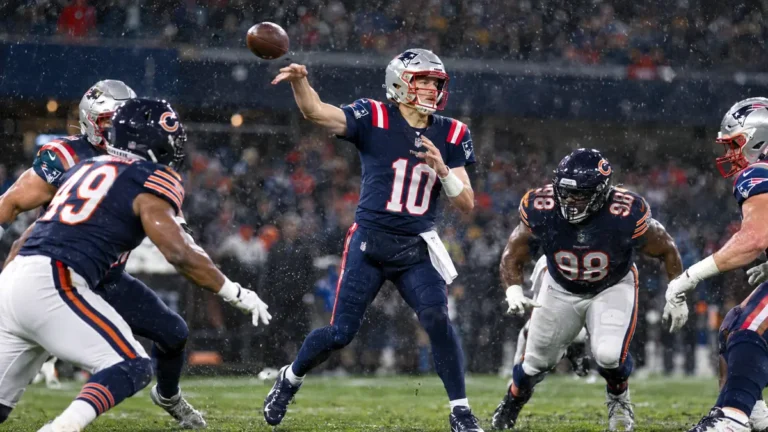
The Miami Dolphins vs New York Jets rivalry delivered another lopsided chapter in Week 14, with Miami bulldozing New York 34-10 at MetLife Stadium. The Dolphins didn’t just win—they dismantled the Jets on the ground, racking up 239 rushing yards while holding New York to a measly 65 yards on 17 carries. If you’re searching for the box score, player stats, or the exact reasons this game spiraled out of control for the Jets, this breakdown covers every measurable angle.
Match Overview
| Information | Match Details |
| Event | NFL Regular Season (Week 14) |
| Game | Miami Dolphins vs New York Jets |
| Date | December 7, 2025 |
| Venue | MetLife Stadium, East Rutherford, NJ |
| Attendance | Not officially disclosed in available sources |
| Winner | Miami Dolphins |
| Final Score | 34-10 |
| Broadcast | CBS (regional coverage) |
Miami entered this matchup riding a three-game win streak powered by a resurgent rushing attack. That trend didn’t just continue against New York—it exploded. The Dolphins scored touchdowns on three of their first four possessions, built a 21-0 lead before the Jets recorded a single first down, and never allowed New York within two scores after the opening quarter .
The Jets, already eliminated from playoff contention after this loss, suffered their tenth defeat of the season. Quarterback Tyrod Taylor exited in the first quarter with a groin injury, forcing undrafted rookie Brady Cook into action against a relentless Miami pass rush that finished with six sacks and three interceptions .
Core Match Statistics Overview
| Metric | Dolphins | Jets |
| Total Yards | 342 | 207 |
| Rushing Yards | 239 | 65 |
| Rushing Yards Per Attempt | 6.3 | 3.8 |
| Passing Yards | 103 | 142 |
| First Downs | 20 | 10 |
| Third Down Efficiency | 6/13 (46%) | 1/12 (8%) |
| Turnovers | 0 | 3 |
| Sacks Allowed | 0 | 6 |
| Time of Possession | 33:12 | 26:48 |
Rushing Dominance
The Dolphins averaged 6.3 yards per carry compared to New York’s 3.8, a gap that reflects both superior blocking and a schematic commitment to the ground game. Miami’s offensive line consistently reset the line of scrimmage, opening lanes that turned modest gains into chunk plays .
De’Von Achane needed just seven carries to accumulate 92 yards before exiting with a rib injury. His replacement, Jaylen Wright, pounded out 107 yards on 24 attempts—the first 100-yard game of his career .
Third Down Futility
The Jets converted one of twelve third-down attempts. That 8% conversion rate isn’t a fluke—it’s a symptom of predictable play-calling, protection breakdowns, and a complete inability to sustain drives against a defense that knew exactly where the pressure needed to come from .
Turnover Margin
Miami forced three interceptions and recovered a fumble, finishing plus-three in turnover differential. The Dolphins converted those takeaways into 14 points, effectively turning a competitive first quarter into a rout by halftime .
Period-by-Period Analysis
First Quarter
| Team | Points |
| Dolphins | 21 |
| Jets | 7 |
Miami opened with a four-play, 69-yard touchdown drive capped by Tua Tagovailoa’s 3-yard pass to Jaylen Waddle. The drive featured a 39-yard Achane run that immediately exposed New York’s run-fit issues .- After a Jets three-and-out, Miami marched 80 yards in five plays, with Achane punching in a 13-yard score. By this point, the Dolphins had run 11 offensive plays and gained 149 yards .
- Tyrel Dodson intercepted Taylor on the ensuing possession, setting up Wright’s 2-yard touchdown plunge. Isaiah Williams returned a punt 78 yards for New York’s only score of the half, but the damage was already done .
Second Quarter
| Team | Points |
| Dolphins | 3 |
| Jets | 0 |
Miami’s offense cooled slightly, but Riley Patterson’s 43-yard field goal extended the lead to 24-7. The drive consumed over five minutes and kept New York’s defense on the field .- Rasul Douglas intercepted Cook at the goal line on New York’s best drive of the half, preserving the three-score cushion entering halftime .
Third Quarter
| Team | Points |
| Dolphins | 0 |
| Jets | 0 |
Zach Sieler and Bradley Chubb combined for a sack on New York’s opening possession, forcing a punt and setting the tone for a scoreless quarter .- Miami leaned on Wright between the tackles, chewing clock and keeping Cook off the field. The Jets managed just 47 total yards in the first half and didn’t fare much better in the third .
Fourth Quarter
| Team | Points |
| Dolphins | 10 |
| Jets | 3 |
Nick Folk’s 31-yard field goal cut the deficit to 24-10, briefly giving New York hope. But Miami answered with a nine-play, 67-yard drive capped by Ollie Gordon II’s 7-yard touchdown run .- Patterson’s 53-yard field goal sealed the scoring. Ethan Bonner intercepted Cook in the end zone with just over a minute remaining, punctuating the defensive effort .
Detailed Team Player Statistics
Miami Dolphins Player Statistics
Tua Tagovailoa, QB
- 13/21 passing, 127 yards, 1 TD, 0 INT
- Managed the game efficiently, avoiding turnovers and converting key third downs early. His 3-yard touchdown to Waddle set the tone for a mistake-free afternoon.
Jaylen Wright, RB
- 24 carries, 107 yards, 1 TD
- The second-year back delivered the most productive game of his career, consistently falling forward and absorbing contact. His physical running style wore down New York’s front seven in the second half .
De’Von Achane, RB
- 7 carries, 92 yards, 1 TD; 1 reception, 3 yards
- Achane’s explosiveness was on full display before a rib injury ended his day. He averaged 13.1 yards per carry and scored on a 13-yard run that showcased his acceleration through the second level .
Jaylen Waddle, WR
- 5 receptions, 50 yards, 1 TD
- Waddle was Tagovailoa’s most reliable target, converting critical third downs and scoring the opening touchdown. His 21-yard grab on the first drive set up Miami’s early advantage .
New York Jets Player Statistics
Brady Cook, QB
- 14/30 passing, 163 yards, 0 TD, 2 INT
- Thrust into action after Taylor’s injury, Cook showed poise early but unraveled against consistent pressure. Both interceptions came in scoring territory, killing New York’s best chances .
Breece Hall, RB
- 12 carries, 45 yards; 3 receptions, 18 yards
- Hall found little room to operate behind a patchwork offensive line. His longest run went for eight yards, and he was frequently met in the backfield by unblocked defenders .
Isaiah Williams, WR/Returner
- 1 punt return, 78 yards, 1 TD
- Williams provided New York’s only touchdown on a spectacular punt return in the first quarter. His speed briefly shifted momentum before Miami’s defense reasserted control .
Statistical Leaders Summary
| Category | Dolphins | Jets |
| Leading Rusher | Jaylen Wright (107) | Breece Hall (45) |
| Leading Passer | Tua Tagovailoa (127) | Brady Cook (163) |
| Leading Receiver | Jaylen Waddle (50) | Mason Taylor (42) |
| Top Defender | Zach Sieler (2.5 sacks) | Jamien Sherwood (8 tackles) |
Why the Dolphins Won
Relentless Ground Attack
Miami’s 239 rushing yards weren’t just a season high—they represented a philosophical commitment that New York couldn’t match. The Dolphins ran 38 times compared to 21 pass attempts, controlling tempo and keeping their defense fresh .
| Rushing Metric | Dolphins | Jets |
| Attempts | 38 | 17 |
| Yards | 239 | 65 |
| Yards Per Carry | 6.3 | 3.8 |
| Rushing Touchdowns | 3 | 0 |
Defensive Splash Plays
Six sacks and three interceptions tell the story of a defense that overwhelmed a backup quarterback. Sieler’s 2.5 sacks were a career high, while Chop Robinson’s strip-sack and Bonner’s end-zone interception highlighted a unit operating at peak cohesion .
Red Zone Efficiency
Miami scored touchdowns on all three of its red-zone trips. The Dolphins didn’t settle for field goals when the game was still competitive, and that aggressiveness buried New York early.
Why the Jets Lost
Quarterback Instability
Taylor’s injury forced Cook into a situation no rookie should face: trailing by three touchdowns against a defense pinning its ears back. Cook’s two interceptions came on throws he’d likely want back, but the protection in front of him collapsed repeatedly .
Third Down Collapse
One conversion in twelve attempts is a recipe for defensive exhaustion. The Jets averaged 3.2 plays per drive in the first half, leaving their defense on the field for extended stretches that compounded Miami’s rushing dominance .
Inability to Stop the Run
New York’s defensive front was pushed off the ball consistently. Achane and Wright combined for 199 yards on 31 carries, and the Jets never adjusted their fits or brought extra defenders into the box with any effectiveness.
Historical Context & Season Series
| Date | Result | Location |
| September 29, 2025 | Dolphins 27, Jets 21 | Hard Rock Stadium |
| December 7, 2025 | Dolphins 34, Jets 10 | MetLife Stadium |
The Dolphins swept the season series for the fourth time in six seasons, outscoring New York 61-31 across two meetings .
Advanced Insight: Efficiency Per Play
Miami averaged 6.3 yards per play on 54 offensive snaps. New York managed 3.8 yards per play on 55 snaps. That 2.5-yard gap, multiplied across the game’s possessions, explains the final margin more cleanly than any single statistic. The Dolphins didn’t need explosive passing—they simply won the down-to-down efficiency battle on both sides of the ball.
Game Implications
What This Means for Miami
- The fourth straight win kept Miami’s faint playoff hopes alive at 6-7, though the team would need significant help down the stretch .
- Jaylen Wright’s emergence gives the Dolphins a credible insurance policy behind Achane, whose injury history remains a concern.
- The defense’s six-sack performance suggests Anthony Weaver’s unit is peaking at the right time.
What This Means for New York
- The loss officially eliminated the Jets from playoff contention for the fifteenth consecutive season .
- Quarterback depth becomes an urgent offseason priority after Taylor’s injury exposed the gap between the starter and emergency options.
- The run defense’s inability to adjust mid-game reflects a broader schematic rigidity that opponents have exploited repeatedly.
Key Lessons
- A dominant offensive line can neutralize quarterback limitations; Tagovailoa attempted only 21 passes because he didn’t need to do more.
- Turnover differential remains the most reliable predictor of blowouts; Miami’s plus-three margin translated directly to points.
- Backup quarterbacks facing top-tier pass rushes rarely succeed without a functioning run game to lean on.
- Punt return touchdowns can briefly shift momentum, but they don’t fix systemic offensive failures.
- Third-down defense is a leading indicator of defensive exhaustion; the Jets’ 8% conversion rate kept their defense on the field too long.
Conclusion
Week 14’s Miami Dolphins vs. New York Jets game was not determined by quarterback play or clever strategies. It was won in the trenches, where Miami’s offensive line imposed its will and New York’s defensive front had no answer. The Dolphins ran for 239 yards, controlled the clock, and let their defense feast on a rookie quarterback forced into an impossible situation. The Jets have yet to resolve the formula that has characterized this rivalry’s recent history: efficiency and physicality triumph over desperation and disorganization.
Share This Article